EC-Prune: Removing Noisy Boundary Nodes Lets Any Graph Model Transfer Across Domains
ICML 2026 Workshop
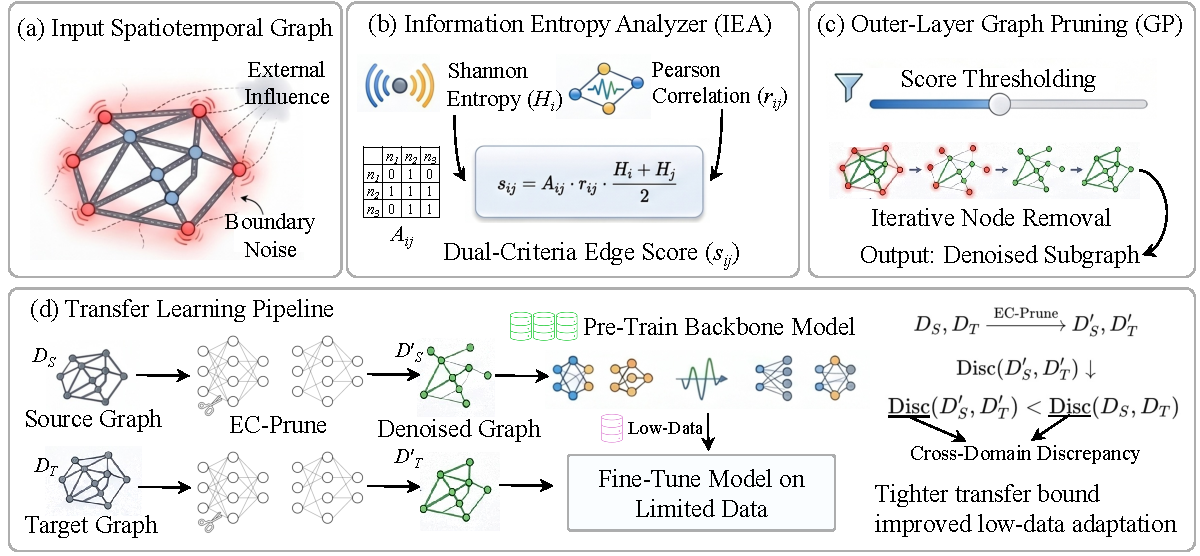
Situation: Graph models trained on one domain often degrade when deployed to a new one, partly because sensors at the graph boundary capture external signals not represented in the model — injecting noise that inflates distributional shift across domains. Task: Reduce cross-domain distributional shift at the data level, without requiring any changes to the downstream model. Action: Designed a preprocessing module that scores each node by how informative and temporally stable it is, then iteratively removes noisy outer-layer nodes to produce a compact, boundary-denoised graph that any model can use as a drop-in replacement. Result: Achieves an average 14.1% gain across five baselines spanning different architectural families on two cross-domain transfer benchmarks, without modifying any model.
Background & Challenge
Two compounding factors drive performance degradation in cross-domain graph transfer:
1. Boundary-induced noise inflates distributional shift. Real-world graphs are open systems — nodes at the periphery are influenced by external regions not modeled in the graph. These boundary nodes carry confounded signals that vary systematically between domains, creating a source of distributional shift that prior work largely ignores while focusing on model-level adaptation.
2. Target data scarcity leaves no margin for error. Cross-domain deployment typically has access to only a small fraction of target-domain training data. Under this constraint, any residual distributional mismatch — including boundary noise — compounds into significant performance degradation across all downstream metrics.
Methodology
Stage 1 — Edge Scoring
Each edge is scored by two complementary signals: how variable each node's signal is (high entropy = informative) and how temporally correlated the two nodes are (high correlation = reliable). Nodes whose signals are confounded by external traffic tend to score low on correlation with their in-graph neighbors. Combining both signals into a single per-edge score filters out connections where one or both endpoints are boundary-noisy.
Ablation: using correlation alone or entropy alone both underperform the combined score; edge-level thresholding without the outer-layer removal step also fails to recover the full gain.
Stage 2 — Iterative Outer-Layer Removal
Edges below the score threshold are dropped. Nodes with too few remaining connections are identified as outer-layer and removed along with all their edges. This process repeats for several rounds, peeling away concentric rings of boundary noise. The result is a compact, boundary-denoised subgraph used as a drop-in replacement for the raw graph in both source pretraining and target fine-tuning.
Results
Setup
- Transfer benchmarks: METR-LA → PEMSD7-M and METR-LA → PEMS-BAY, using only 10% of target-domain training data
- Baselines: STGCN, DCRNN, Graph WaveNet, ASTGNN, PDFormer — spanning CNN, RNN, adaptive-graph, and Transformer architectures
- Evaluation: MAE, MAPE (%), RMSE at 15-min and 30-min horizons
- EC-Prune is added as a preprocessing step only; all other hyperparameters held fixed
Main Results
| Model | Avg. Gain |
|---|---|
| STGCN + EC-Prune | 7.4% |
| DCRNN + EC-Prune | 15.8% |
| Graph WaveNet + EC-Prune | 8.7% |
| ASTGNN + EC-Prune | 17.3% |
| PDFormer + EC-Prune | 21.2% |
| Average | 14.1% |
EC-Prune consistently reduces all three metrics for every baseline across both target datasets and both horizons. Uniform gains across CNN-based and Transformer-based architectures confirm the improvement is architecture-agnostic.
Ablation Study
| Variant | MAE@15 | RMSE@15 |
|---|---|---|
| No pruning | 3.24 | 5.27 |
| Correlation-only | 3.19 | 5.28 |
| Entropy-only | 3.14 | 5.38 |
| Score threshold, no outer-layer removal | 3.10 | 5.44 |
| EC-Prune (full) | 3.09 | 5.17 |
Edge-level thresholding alone does not eliminate all harmful boundary nodes — iterative outer-layer removal is essential for the full gain.
Field Contribution
EC-Prune is the first method to target boundary-node noise as a principal source of cross-domain shift in spatiotemporal graph transfer, addressing it entirely at the data level without any model changes. The preprocessing step is model-agnostic, requires no additional parameters, and consistently improves any graph forecasting backbone — opening a complementary data-centric direction alongside model-level domain adaptation.
Citation
@inproceedings{jing2026ecprune,
  title={EC-Prune: Data-Centric Graph Pruning for Spatiotemporal Foundation Model Adaptation},
  author={Anonymous Author(s)},
  booktitle={ICML 2026 Workshop},
  year={2026}
}